
The Editor's Reconstruction
The Sorrows of Young WertherThis flow traces how the Editor takes over after Werther's letters stop and constructs an account of the final events from testimony and papers.
increasing Bearing strength in each event
 decreasing
Bearing strength in each eventdecreasingThe Letters Break Off
A Change of Narrator
Missing evidence
The Editor tells readers that the surviving correspondence does not cover Werther's last days. He must rely on accounts gathered from people who knew the events.
A mediated story
The shift reminds the reader that Werther's life now appears through testimony and editorial judgment. The final account is not simply another letter from the person whose feelings have dominated the narrative.
Accounts Gathered
Reconstructing the Record
Agreement and disagreement
The Editor reports that witnesses broadly agree on the sequence of events but differ in their judgments of the people involved. He promises to relate what can be established carefully.
Motives remain uncertain
The task is difficult because the inner reasons for an unusual person's actions cannot be fully recovered. The narrative therefore distinguishes visible events from the interpretations attached to them.
The Final Weeks Interpreted
A Life Seen from Outside
Distress observed
The Editor describes Werther's growing exhaustion and isolation, using other people's views as well as fragments from his papers. Albert's friends insist that Albert's character has remained consistent.
Competing judgments
The account complicates Werther's own interpretation of Albert as an obstacle. What Werther experiences as rejection may also be the consequence of his increasing inability to read others fairly.
The Letters as Evidence
Private Writing Preserved
Fragments made public
The Editor inserts notes and letters that reveal Werther's thoughts about death, separation, and the borrowed pistols. These documents give access to his inner life without making his interpretation definitive.
The reader's double perspective
Werther's words invite sympathy, while the external narration reveals the impact of his actions on Lotte and her family. The two perspectives resist a simple account of his death as either pure sacrifice or mere scandal.
Burial Without a Priest
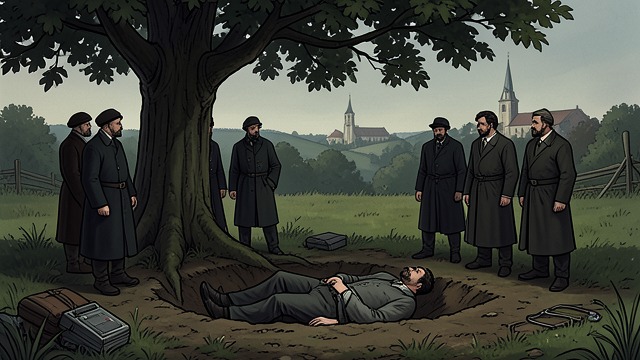
A Final Public Image
The chosen grave
The Editor reports that the steward arranged for Werther to be buried near the lime trees he had selected. The steward and his sons followed the body.
An unresolved ending
No priest attended, Albert could not go, and Lotte's life was feared to be in danger. The Editor closes with facts rather than a settled moral judgment, leaving the cost of Werther's choices visible.
After Werther's final dated entry
At the beginning of the Editor's concluding narrative
As the Editor recounts Werther's winter decline
During the account of December
The night after Werther dies
